HAAM Index / Systems
Storytelling Tropes Are Emotional Interfaces
What Agent Kim: Reactivated reveals about dramatic ideas humans recognize instantly, anticipate willingly, and keep choosing anyway.
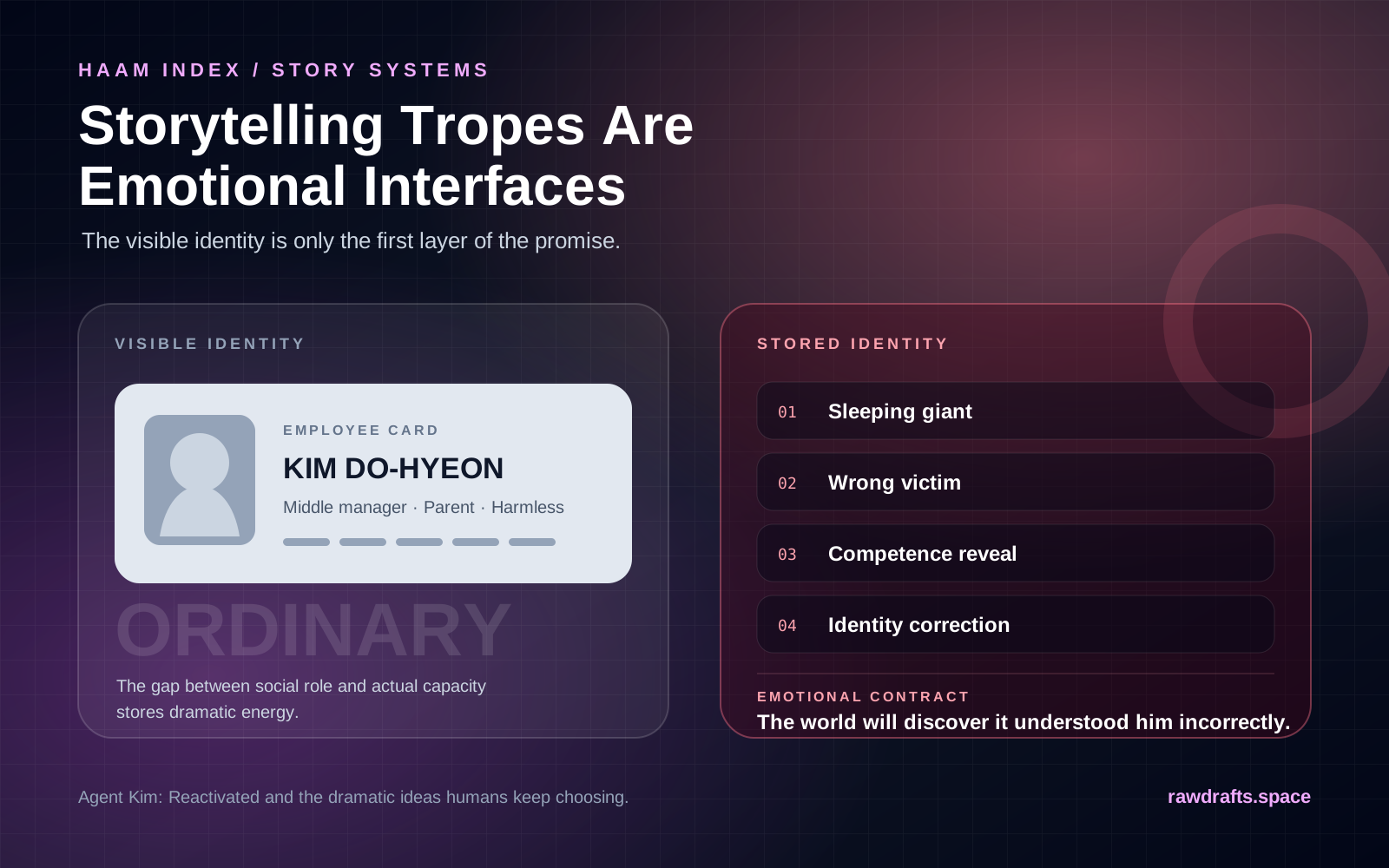
We have seen this story before
A quiet bank manager is pushed around at work.
His teenage daughter sees him as an awkward, emotionally unavailable father. Nobody around him suspects that he was once one of the most dangerous people in the room.
Then his daughter disappears.
The posture changes. The body remembers. The ordinary life is revealed as a carefully maintained disguise.
Agent Kim: Reactivated is adapted from the action webtoon Manager Kim. Its central mechanism is familiar on purpose: a single father and former black-ops member returns to violence when his daughter goes missing.
We know the retired operative will fight again. We know the villain has underestimated him. We know the old friends will become useful. None of this prevents the story from working. The recognition is part of the pleasure.
Ten dramatic promises the series activates
Each trope is more than a recurring plot device. It is a compact promise about the feeling the story may eventually deliver.
01
The ordinary person who is secretly extraordinary
Visible status is not actual value.The bank manager, cleaner, parent, or quiet colleague appears socially unimportant. Then the story reveals an entire hidden life. Everyone who ranked the character too low must update their model.
02
The sleeping giant
Restraint is not weakness.The hero does not need to become powerful. He needs a reason to stop suppressing power he already possesses. Every insult increases the distance between apparent helplessness and stored capacity.
03
The person who matters more than the world
Love turns a mission into necessity.A missing daughter gives the plot an objective that is emotionally enormous and narratively simple. The conspiracy can expand, but the story remains readable in one sentence: he wants her back.
04
The villain who chose the wrong victim
Arrogance creates its own punishment.The antagonist believes the original hierarchy still exists. The audience knows it has already collapsed. Suspense comes from waiting for the villain to understand the mistake.
05
The competence reveal
Skill makes chaos legible.The hero notices more, moves with precision, and solves problems other characters cannot even see. We are not only waiting to learn whether he wins. We want to see how elegantly he changes the situation.
06
The past that refuses to stay buried
Nothing learned is entirely lost.The protagonist changed names, clothes, routines, and relationships, but the former self remains available inside the body. The past becomes dangerous and useful at the same time.
07
The old team reforms
Real loyalty survives inactivity.Former comrades now have ordinary jobs, children, injuries, and complaints. When the call comes, the connection is still operational. Friendship becomes infrastructure.
08
One person against an illegible system
Distributed harm can still be traced.Behind the visible villain sit money, institutions, political influence, and procedural delay. The hero follows the chain until responsibility has a room, a decision, and a face.
09
The identity reveal
The world will finally see correctly.The harmless manager becomes the operative. The disappointing father becomes the protector. Earlier scenes change meaning because silence was control, not weakness.
10
Pain that becomes power
What hurt us might become useful.Grief becomes focus. Humiliation becomes motion. Loss becomes direction. Drama converts passive suffering into agency and suggests that nothing was entirely wasted.
A trope is an emotional interface
An interface lets us approach a complex system through recognizable controls. A trope does something similar for emotion.
The underestimated man, the forbidden room, the one last mission, the hidden heir, and the enemy who becomes an ally all arrive with instructions embedded inside them. We understand what kind of reward might be available before the story delivers it.
The trope is not the complete plot. It is the button.
Show us the ordinary person with a secret past and we anticipate recognition. Show us the villain choosing the wrong victim and we anticipate correction. Show us the old team receiving a call and we anticipate loyalty becoming visible.
This is why familiarity is not automatically the opposite of suspense. The audience can know the destination and still become intensely curious about timing, cost, method, and consequence.
The promise matters more than surprise
A completely unpredictable story is not necessarily interesting. It may simply be random.
Curiosity needs structure. George Loewenstein described it as a response to a perceived gap in knowledge. A familiar dramatic pattern creates that gap efficiently. We know enough to form an expectation, but not enough to close it.
The briefcase will open. We do not know when.
The daughter will learn something about her father. We do not know what that knowledge will repair or destroy.
The villain will discover who Agent Kim really is. We do not know how much damage will already be irreversible.
The story does not have to hide its promise. It has to control the distance between promise and delivery.
Familiarity lowers the cost of entering the story
Recognition reduces explanation. The audience does not need a seminar on why a missing child matters, why a concealed identity produces tension, or why an arrogant antagonist invites correction.
This gives the story more space to work on rhythm, performance, relationships, visual detail, and the precise shape of the payoff.
Research on mere exposure has long suggested that repeated contact can increase positive feeling toward a stimulus. Narrative familiarity is more complicated than repetition alone, but the basic insight matters: recognition can create comfort rather than contempt.
Narrative transportation adds another piece. People become absorbed when attention, imagery, and emotion converge around a story world. A recognizable structure can make that entry faster because the audience already knows how to read the signals.
The audience is not asking only, “What happens next?” It is also asking, “When will the thing I was promised finally happen?”
Tropes compress human wishes
The most durable tropes are not attractive because audiences lack imagination. They are attractive because they compress wishes that are difficult to state directly.
A story trope turns one of these wishes into a visible situation. It gives the desire characters, rooms, objects, timing, and consequences.
The moral world becomes temporarily readable
Real systems distribute responsibility. Harm can pass through departments, contracts, algorithms, subcontractors, and plausible deniability until nobody appears fully accountable.
Action drama reverses that diffusion. It follows the chain upward. The person who caused the harm eventually becomes reachable.
This is one reason revenge and rescue stories can feel emotionally clean even when their physical world is brutal. The fiction constructs a temporary environment in which guilt is visible, loyalty is testable, and consequences arrive on time.
The fantasy is not simply violence. It is causality.
Agent Kim does not only defeat people. He makes the system reveal how it works.
Execution is the difference between ritual and cliché
A familiar pattern is not a guarantee. The missing daughter can become a disposable object. The competent hero can become emotionally flat. The villain can become so cartoonish that punishment loses meaning. The old team can feel like franchise setup rather than friendship.
The trope only identifies a possible reward. The story still has to earn it.
Execution controls how powerless the hero appears before the reveal, how long the first act of competence is delayed, how much agency the daughter retains, whether the old friends imply a believable shared past, and whether power carries a cost.
Originality can come from pressure, rhythm, cultural context, performance, contradiction, visual language, or the precise relationship between familiar parts.
The question is not whether we have seen a retired operative rescue someone he loves. The question is whether this story can make us want to watch the transformation again.
AI can reproduce the trope before it understands the desire
Generative AI is extremely good at naming and recombining recognizable story elements. It can produce the hidden operative, missing child, corrupt corporation, old mentor, encrypted file, betrayed partner, and final confrontation in seconds.
That does not mean it understands why the combination works.
A trope becomes attractive through calibration. How powerless should the hero appear? How long can the reveal be delayed? How cruel can the villain become before the manipulation feels obvious? How much humor is needed to prevent revenge from becoming emotionally flat?
AI can generate ingredients. Storytelling still depends on emotional judgment.
The scarce resource is not plot. It is knowing which human wish the plot is serving.
Story architecture is product architecture
This is where the trope becomes relevant beyond television.
A product also makes promises through recognizable forms. A progress bar promises completion. A marketplace rating promises reduced uncertainty. A before-and-after comparison promises transformation. A dashboard promises that an invisible system can become legible.
These patterns can be useful, manipulative, or empty. Their quality depends on whether the system delivers what the interface teaches people to expect.
Stories and products both organize anticipation. They establish a model, delay an outcome, reveal state, and reward continued attention.
Agent Kim: Reactivated works as a useful case because its emotional architecture is visible. The ordinary manager, missing daughter, sleeping giant, wrong victim, and identity reveal form a chain of promises. Each one prepares the next.
The audience is not tricked by the familiarity. The audience collaborates with it.
We do not love tropes because we were fooled
We recognize these structures while watching them.
We know the ordinary job is a disguise. We know the old team will reunite. We know the antagonist is underestimating the wrong person. We know the daughter will eventually encounter a version of her father that the world was never supposed to see.
Recognition does not destroy the pleasure. It creates the conditions for it.
The trope is a compact emotional agreement between story and audience. It says: stay with me, and this particular feeling will arrive.
The story is what happens while we wait.