


July 7, 2026 · 11 min read · By Kris Haamer
Taipei Blockchain Week 2023: The Ecosystem Was the Interface
A reconstructed field note from a week when Taipei connected public goods, regional venture networks, decentralized science, identity, market infrastructure, and community life into one distributed system.
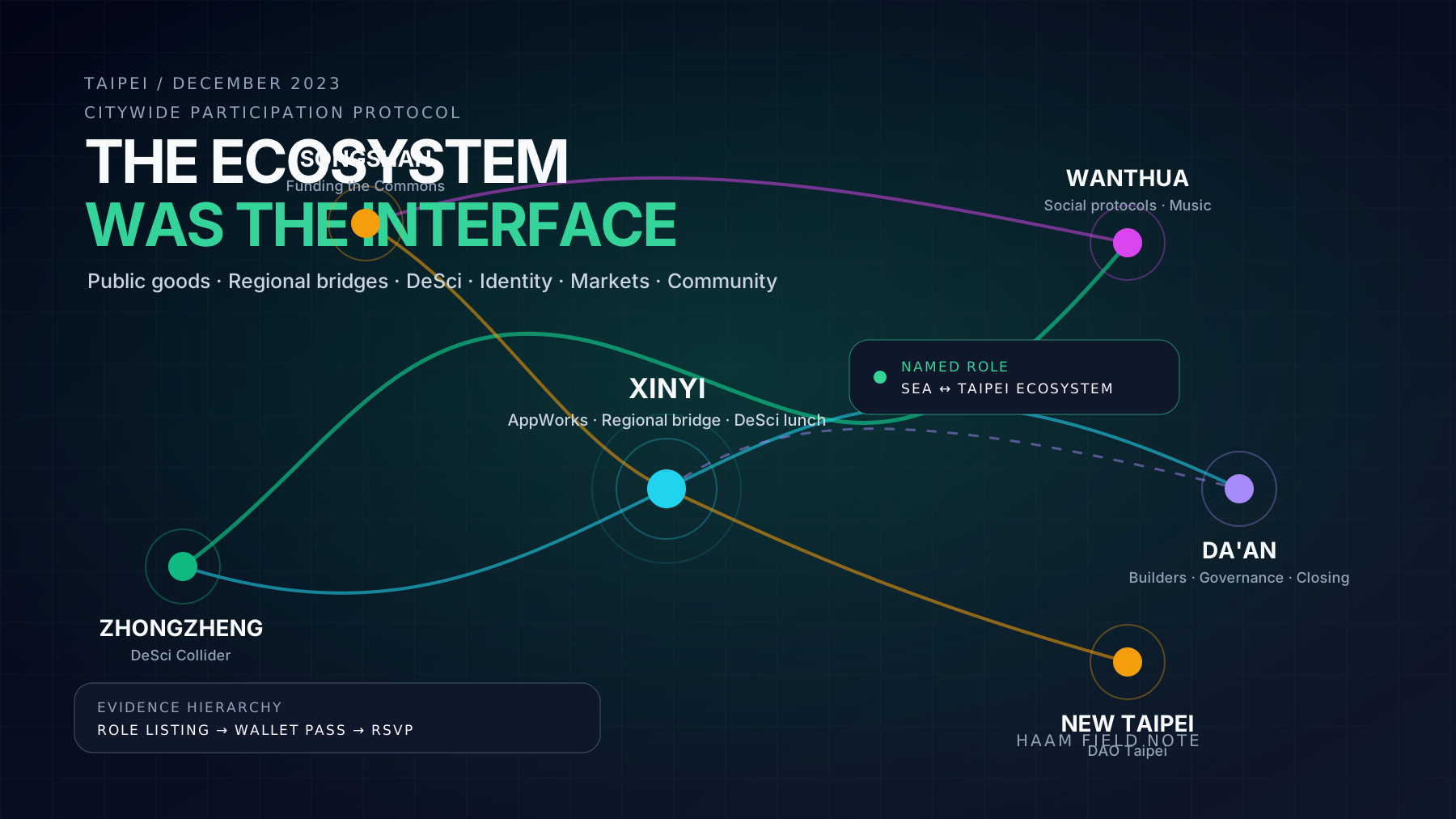
Reconstructed participation trail
What the retained records support
Confirmed role listing
Bridging Southeast Asia and Taipei
The retained event listing names Kris as Venture Lead at Cryptomind Labs and places him on the panel for Power-Bridging Southeast Asia and Taipei Ecosystem at AppWorks on December 14.
Strong registration trail
DeSci and market infrastructure
Accepted registrations and retained Wallet passes remain for DeSci Lunch, DeSci Collider, BitMEX Returns to Taipei, and several other events during the week.
Context record
Funding the Commons Taipei
The calendar records an accepted registration for Funding the Commons on December 10, where public goods, g0v, da0, and Taiwan's digital-democracy context framed the week.
Registration only
A much larger citywide schedule
Many additional accepted RSVPs remain across coworking sessions, runs, protocol meetups, parties, and builder gatherings. They show intent and access, not guaranteed physical entry.
One week, four layers
01
Public goods
Funding the Commons connected blockchain infrastructure to Taiwan's civic-tech history, public funding, and collective governance.
02
Regional bridges
AppWorks, APAC DAO, Cryptomind Labs, and regional partners treated Taipei and Southeast Asia as one connected operating environment.
03
Decentralized science
DeSci events translated research funding, women's health, scientific IP, privacy, and post-quantum security into an emerging product ecosystem.
04
Social routing
Coffee rooms, runs, boba, dinners, night markets, and parties performed the practical work of moving people between communities.
Selected schedule trail
The week moved through the city
Funding the Commons: Taipei 2023
Songshan Cultural and Creative Park
A public-goods gathering developed with da0 around Taipei's civic-tech and digital-democracy context.
Public event source ↗AppWorks Web3 Networking Cafe
AppWorks, Xinyi
A recurring coworking and meeting layer that offered a quieter counter-rhythm to the packed event schedule.
Public event source ↗Power-Bridging Southeast Asia and Taipei Ecosystem
AppWorks, Xinyi
The event listing placed me on the regional ecosystem panel as Venture Lead at Cryptomind Labs alongside APAC DAO, AppWorks, Blockdaemon, and the Blockchain Council Philippines.
Public event source ↗DeSci Lunch at Taipei Blockchain Week
Xinyi
A compact introduction to VitaDAO, Molecule, AthenaDAO, ValleyDAO, research independence, and new models for funding science.
Public event source ↗DeSci Collider
Learn Bar, Zhongzheng
A mini-summit connecting decentralized science with digital identity, zero-knowledge systems, post-quantum cryptography, research coordination, and scientific IP.
Public event source ↗DAO Taipei and Build N' Build in 2024
New Taipei and Da'an
The closing stretch shifted from the week's commercial intensity toward governance, community practice, security, and plans for the next cycle.
Public event source ↗A conference week behaves like a distributed product
Taipei Blockchain Week 2023 occupied more than a venue or a programme. It formed a temporary operating system across Songshan, Xinyi, Da'an, Zhongzheng, Wanhua, and New Taipei. The official conference provided a centre of gravity. The surrounding network supplied the interfaces through which people actually found collaborators, compared ideas, and decided where to spend their attention.
My retained schedule from December 10 to 17 contains dozens of registrations. Some were formal panels and summits. Others were coworking sessions, runs, boba meetups, dinners, protocol gatherings, night markets, and late parties. The volume makes a simple point: participation required continual routing. Every hour involved a choice between depth and breadth, between staying in one room and crossing the city for another community.
That routing layer is part of event design. Calendars, venue geography, host reputation, invitation status, social context, and the probability of a useful conversation all become interface signals. A citywide technology week succeeds when those signals help people form meaningful paths through the noise.
My clearest role was regional translation
The strongest retained record of my own role is the listing for Power-Bridging Southeast Asia and Taipei Ecosystem on December 14. The programme names me as Venture Lead at Cryptomind Labs and places me on a panel with representatives from APAC DAO, AppWorks, Blockdaemon, and the Blockchain Council Philippines.
The event framed Taipei and Southeast Asia as two powerful Web3 hubs that could share builders, capital, infrastructure, and market knowledge. That framing matched the work I was doing across cultures and ecosystems. Translation in this setting means more than language. It means explaining how trust forms, how communities organise, which assumptions travel well, and which product behaviours remain deeply local.
For HAAM, that remains a useful position. International products need people who can move between technical systems, cultural expectations, organisations, and everyday user behaviour without flattening the differences between them.
Taiwan's public-goods culture changed the meaning of Web3
The week began in my calendar with Funding the Commons at Songshan Cultural and Creative Park. Its Taipei edition explicitly connected public-goods funding with g0v, da0, civic technology, and Taiwan's experience of digital democracy.
That context matters because infrastructure is never purely technical. Governance, public legitimacy, access, maintenance, and accountability shape whether a system becomes useful. Taipei offered an unusually concrete environment for those questions because its civic-tech community had already demonstrated how open collaboration could interact with public institutions.
The useful lesson was that decentralisation gains meaning through the social systems around it. Protocols need communities that can debate priorities, document decisions, distribute responsibility, and keep institutions answerable to the people affected by them.
DeSci made abstract infrastructure tangible
My retained event trail includes an AthenaDAO breakfast, a DeSci lunch, a fertility session, and DeSci Collider. Together, their programmes moved across women's health, longevity, synthetic biology, research funding, scientific intellectual property, digital identity, privacy, and post-quantum cryptography.
This range showed why decentralized science is also an interaction-design problem. A research-funding system needs understandable participation rules. Scientific IP needs legible ownership and licensing. Privacy systems need usable proofs. Communities need ways to evaluate expertise without recreating the same closed institutions they are trying to improve.
The design challenge sits between ambitious infrastructure and human confidence. People need to understand what they are funding, which claims are verified, who remains accountable, what rights a token or credential represents, and how a decision can be challenged or reversed.
The social layer carried the technical layer
The week included formal ecosystem panels alongside a Farcaster boba meetup, Nouns runs, the AppWorks cafe, builder mixers, a night market, social-protocol events, art gatherings, and multiple closing parties. These formats may look peripheral when compared with a conference stage. In practice, they often provide the lower-pressure environments where people can ask basic questions, test trust, and discover unexpected overlap.
Taipei made this social infrastructure visible. The city offered compact neighbourhoods, reliable transit, dense food and nightlife, and many event formats within a short radius. Each venue created a different interaction contract. A panel rewarded concise positioning. A coworking room enabled longer work. A run reduced hierarchy. A dinner supported context. A party accelerated introductions while reducing the depth available to each one.
Good ecosystem design uses these formats intentionally. A healthy week needs places for visibility, learning, production, recovery, and sustained conversation. Constant intensity produces more check-ins and fewer meaningful outcomes.
What Taipei Blockchain Week contributed to HAAM
The experience strengthened several principles that now sit inside HAAM's work. Context is infrastructure. Trust needs visible evidence. International ecosystems require translation. Communities need multiple participation modes. Interfaces should help people understand who acts, who benefits, and who remains responsible.
It also reinforced the value of fieldwork. Product teams can read protocol documentation and market reports from anywhere. Being inside the surrounding rooms reveals the human layer: what people struggle to explain, which promises repeatedly attract attention, where confusion appears, and how status or social pressure changes decisions.
Taipei Blockchain Week became useful to me as a map of relationships between technology, capital, public goods, science, identity, culture, and city life. That map still informs how I approach complex products today.