


HAAM Index / Systems / Design Education
July 4, 2026 · 16 min read · By Kris Haamer
Every Interface Has a Site
What architecture studios, industrial design classes, and ICID at National Cheng Kung University taught me about locating a digital system before giving it form.
Drawing set 01
Territory to detail
Tainan, Taiwan
Scale: variable
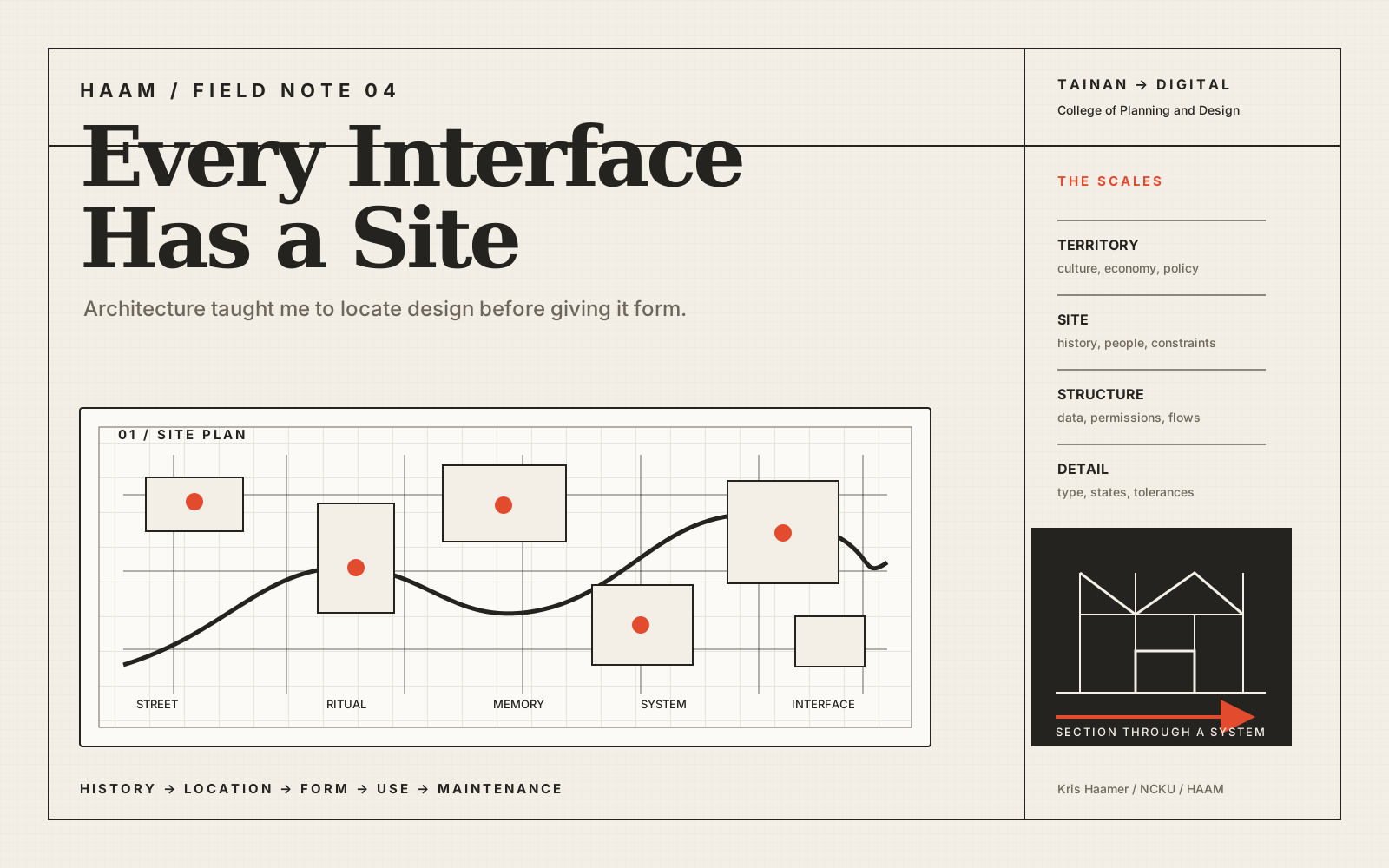
Working thesis
A building cannot simply arrive on a site. Neither can an interface. Both enter places already shaped by history, infrastructure, habits, power, and memory.
Culture, policy, economy, institutions, technology, and public expectations.
People, histories, rituals, constraints, existing systems, and unresolved tensions.
Information, permissions, workflows, data, responsibility, and maintenance.
Components, states, language, tolerances, transitions, and implementation.
01 / ENTRY
I entered through interaction design
I went to National Cheng Kung University to study interaction design, but much of the education that stayed with me happened beyond the formal boundaries of interaction design.
I spent many hours watching architecture professors teach. I watched critiques unfold around drawings, models, plans, sections, material decisions, and the histories of particular places. The discussion rarely began with whether a building looked good.
It began with location.
Why here? What was here before? Which direction did the sun move across the site? Where did wind, rain, traffic, shade, noise, ritual, commerce, and memory enter the proposal? What did the new structure preserve, obstruct, expose, or make possible?
I also spent many hours in classes in the Department of Industrial Design. There, the scale changed. The city and site contracted into the object, the body, the joint, the surface, the manufacturing process, and the repeated act of use.
Between architecture and industrial design, I learned to move from territory to detail.
Architecture taught me to ask whether a design belonged there. Industrial design taught me to ask whether it could actually live in the world.
02 / SITE
The site comes before the object
In architecture, a site is not an empty rectangle waiting for a concept.
It is already full. It contains weather, topography, infrastructure, regulation, earlier structures, economic pressure, political decisions, habits of movement, and memories that may never appear on an official map.
The architect does not begin by pretending these forces are absent. The proposal becomes meaningful through its response to them.
Digital design is often approached in the opposite order. A team begins with a feature list, a visual direction, or a technological possibility. Research appears later, sometimes as evidence arranged around a form that has already been chosen.
At NCKU, the architectural perspective taught me to reverse that sequence.
First, locate the project. Where does it live? What existed before it? Which systems already shape behaviour there? Who controls access? What language do people use? What does the organisation remember? What has it forgotten? Which informal workarounds are carrying more weight than the formal process?
Only then should the form begin to emerge.
This became foundational to HAAM. A website is inserted into the history of an organisation. A new service enters workflows that may have developed over decades. An AI agent enters an existing relationship between knowledge, authority, labour, and responsibility.
The visible product is only the newest layer.
03 / HISTORY
Tainan taught me that places are built through accumulation
In Tainan, history is not limited to monuments. It remains active in street widths, temple forecourts, shopfronts, alleys, arcades, courtyards, drainage, improvised extensions, and the shifting boundary between private and public life.
The city is not one coherent object. It is a long negotiation between periods, uses, owners, climates, technologies, and beliefs.
One layer does not completely erase the previous one. A structure is repaired, subdivided, covered, reopened, extended, repurposed, and interpreted again. Its meaning changes while earlier lives remain partially visible.
Digital systems accumulate in the same way.
A website contains old decisions, abandoned campaigns, database structures, analytics conventions, internal politics, translation choices, and technical compromises. A redesign does not erase these histories because the new interface uses cleaner typography.
The existing system remains underneath.
This is why redesigning without understanding history so often creates something visually coherent but structurally false. The new interface may contradict how the organisation actually works. It may delete knowledge that appeared messy but served a real purpose. It may impose a universal pattern on a situation that required a local response.
At HAAM, I try to work with the existing conditions rather than stage the fiction of a blank canvas.
Sometimes the task is not to replace a system, but to reveal its structure. Sometimes it is to preserve what remains useful while removing what has become obstructive. Sometimes the responsible intervention is smaller than the initial ambition.
04 / COLLEGE
ICID made sense because of what surrounded it
The Institute of Creative Industries Design sits inside NCKU's College of Planning and Design. The college brings together architecture, urban planning, industrial design, ICID, techno art, and design thinking.
That proximity is not only administrative. It changes the intellectual climate.
ICID itself has roots in industrial design, but its official description traces a shift from product orientation toward industrial planning, enterprise innovation, products, services, strategy, and technology. Its programs connect brand and marketing planning, media and interaction design, and industry and service innovation.
I was studying media and interaction design, but the building around that education was wider. Design was continuously connected to planning, management, industry, culture, policy, research, services, and entrepreneurship.
It became difficult to treat an interface as an isolated encounter between a person and a screen.
A shopping interface is connected to logistics, labour, finance, environmental impact, retail infrastructure, and regulation. A cultural website is connected to institutional memory, funding, rights, translation, curation, and public access. A financial AI companion is connected to trust, financial anxiety, behavioural incentives, data, and the authority to recommend an action.
The interface is where these systems become visible, but it is not where they begin.
05 / FORM
Form is a resolution of forces
Architecture taught me that form is not merely visual expression.
A wall may respond to structure, climate, acoustics, privacy, cost, craft, maintenance, and circulation at the same time. A courtyard may organise movement, light, ventilation, social contact, ritual, and memory through a single spatial decision.
The strongest decisions are rarely isolated. They resolve several forces together.
A navigation structure works the same way. It is not only a way of arranging pages. It expresses how an organisation understands itself, what it prioritises, and what it allows visitors to find.
A permission system is not only technical infrastructure. It distributes power. A database is not merely storage. It decides what the organisation can remember. A dashboard is not simply a collection of charts. It determines which realities are allowed to become visible enough to influence a decision.
A good interface does not decorate the system. It clarifies relationships inside it.
This is why HAAM works across research, product direction, content, interaction design, accessibility, implementation, measurement, and long-term maintenance. These are not separate surfaces attached to the same project. They are forces shaping the same structure.
06 / OBJECT
Industrial design brought the hand back into the system
Architecture expanded the scale at which I understood context. Industrial design brought me back to the object with a more demanding attention to reality.
Industrial design asks how something is held, touched, assembled, manufactured, cleaned, repaired, transported, and used repeatedly. It treats dimensions, weight, texture, tolerances, joints, materials, production methods, and human factors as part of the concept.
A chair cannot survive as an idea. It has to stand. It has to carry weight. It has to respond to the body. Its joints have to endure. Its material has to age. Its production process has to exist somewhere beyond the rendering.
This changed how I thought about digital products.
A user flow has joints. A design system has tolerances. A component has states. A product has production constraints. An interaction has to survive repetition, interruption, poor connectivity, long translations, incorrect input, and use that the designer did not predict.
The polished mock-up is comparable to the product rendering. It shows intent, but not yet life.
07 / SCALE
The designer must move continuously between the city and the door handle
Architecture moves between scales.
A critique may begin with the region, move to the city, then the neighbourhood, plot, building, room, wall, and finally the detail where two materials meet. Each scale changes the meaning of the others.
A beautiful joint cannot rescue a building that ignores its surroundings. A compelling urban concept cannot succeed if a person cannot comfortably enter the door.
Interaction design should operate in the same way.
A project may begin with a cultural, financial, environmental, or organisational condition. It moves through stakeholders, service structures, information architecture, user journeys, interface systems, components, states, typography, spacing, and motion.
The smallest detail still belongs to the largest intention.
A button label may reveal whether a system respects uncertainty. A loading state may show whether the product understands unstable connectivity. A name field may expose assumptions about identity and language. A missing export function may reveal who the system believes owns the data.
The detail is where the philosophy becomes tangible.
At HAAM, I want strategy and implementation to remain connected. The person shaping the direction should understand how it behaves at component level. The concept should survive contact with the browser, the database, the organisation, and the person using it.
The idea becomes real where the parts meet.
08 / TIME
Launch is the moment of occupation, not completion
A building is never experienced only at the moment the architect finishes the drawings.
It is occupied. It weathers. People place furniture inside it, change routes, block doors, open windows, repair surfaces, neglect systems, adapt rooms, and find uses that were not anticipated.
Architecture exists in time.
Digital products do too, but technology culture often treats launch as the final photograph. The product goes live, the case study is published, and the team moves on.
Then the actual life of the system begins.
Content becomes outdated. Organisations change. Third-party services disappear. Interfaces accumulate exceptions. New users arrive. Old assumptions stop being true. The system begins to reveal what the original design did not understand.
A planning perspective makes this future part of the initial design problem.
Who will maintain the system? What knowledge must remain accessible? Which elements should be adaptable? What evidence will show whether the intervention works? What happens when the original designer is no longer present?
At HAAM, launch should be treated like occupation. It is the beginning of evidence.
09 / RESEARCH
Green Filter began as site analysis
My NCKU thesis, Green Filter, became a financial AI companion for young adults in Taiwan, connecting sustainable shopping with saving and investing.
But before there could be a product, there had to be a site.
The site was not only geographic. It included financial anxiety, consumption habits, environmental concern, health priorities, family influence, trust in technology, and the distance between what people say they value and what they do during an ordinary purchase.
The research included more than 900 survey responses across over 48 educational institutions, 32 interviews, self-guided testing, and prototype evaluations with participants from seven universities.
Those activities functioned like surveys of terrain. They revealed patterns, constraints, contradictions, routes, and forces that were not visible in the initial idea.
The product could not simply tell people to consume more sustainably. It had to understand that sustainability was already entangled with money, health, convenience, identity, knowledge, and uncertainty.
Research was not decoration around the design. It was the ground from which the design grew.
10 / INFRASTRUCTURE
WiFi.ee is a small piece of digital urban infrastructure
WiFi.ee can be described as a map of public Wi-Fi locations.
From a planning perspective, it is closer to infrastructure.
A public connection does not consist only of a point on a map. It involves a physical place, an owner, a router, a network name, a login process, a level of reliability, safety conditions, accessibility, and information that can quickly become outdated.
The visible map is the public edge of this system.
Behind it are questions of verification, maintenance, trust, ownership, access, and collective responsibility. Who keeps the information accurate? How can someone know whether a location is still usable? What does it mean for a network to be public? How should risks be communicated? How can venue owners participate without controlling the entire platform?
These are planning questions.
The aim is not simply to draw points. It is to create conditions in which public connectivity can be found, understood, verified, and maintained.
11 / GOVERNANCE
AI also needs a site
AI products are often presented as if intelligence could be inserted into any interface without changing the surrounding environment.
But AI always enters an existing territory.
It enters institutions with hierarchies, datasets with histories, workflows with informal rules, and relationships in which authority is already unevenly distributed.
The important question is not only what the model can generate. It is where the model is being placed.
Who defined its purpose? What information can it access? Which decisions can it influence? Who can question the output? Where does human responsibility remain? What happens when the system is uncertain or wrong?
These resemble the questions asked before an intervention in a physical site. What forces are present? Who controls the territory? Who will be affected? Which histories are embedded there? Which consequences will travel beyond the formal boundaries of the project?
At HAAM, AI is treated as part of a larger architecture of responsibility. The model is one component. The surrounding system determines what that component is allowed to mean and do.
12 / PRACTICE
HAAM is an interaction design practice with a planner's brain
HAAM is intentionally small. I work directly across research, product direction, interaction design, and front-end implementation, bringing in named specialists when their knowledge is genuinely needed.
The purpose is not to imitate a large agency with fewer people. It is to preserve the connection between understanding a situation and building the intervention.
NCKU gave me a clearer language for that instinct.
Architecture taught me to begin with location, history, climate, movement, and occupation.
Planning taught me to examine systems, stakeholders, public consequences, and time.
Industrial design taught me to respect the object, body, material, joint, tolerance, production process, and repeated act of use.
ICID provided the field where interaction design could coexist with branding, services, industry, culture, research, management, technology, policy, and entrepreneurship.
Interaction design became the place where these ways of seeing could meet.
A digital product has a context like a building. It has structure like an object. It has circulation, thresholds, permissions, public and private zones, visible surfaces, hidden infrastructure, and patterns of occupation.
It ages. It can be maintained well or badly. It can belong to its environment or feel imported from somewhere else. It can help people understand where they are, or leave them disoriented.
This is the education that became part of HAAM.
Before designing the interface, understand the site. Before proposing the new, study what is already there. Before choosing the form, identify the forces shaping it. Before calling something complete, imagine how it will live over time.
Every interface has a location.
Every product enters a history.
Every design leaves something behind.
Sources and institutional context
- NCKU College of Planning and Design, Departments and programs.
- Institute of Creative Industries Design, About, Origins, features, and cross-disciplinary objectives.
- ICID Programs, Brand and Marketing Planning, Media and Interaction Design, and Industry and Service Innovation.
- ICID Courses, Core and elective curriculum.
- NCKU Department of Architecture, Institutional history and role.
- NCKU Department of Industrial Design, Educational focus and research groups.
Continue through HAAM
- Green Filter, sustainable shopping, saving, investing, and financial AI.
- WiFi.ee, public connectivity as maintained digital infrastructure.
- Interaction Design, turning system conditions into usable interfaces.
- How HAAM Works, from context and planning through implementation and iteration.